Showing posts with label Visit of Swami Vivekananda to Sri Lanka. Show all posts

Saturday, August 1, 2026

Narada Bhakt Sutra on Holy Association


Bhaja Govindam

सत्संगत्वे निस्संगत्वं, निस्संगत्वे निर्मोहत्वं।
निर्मोहत्वे निश्चलतत्त्वं, निश्चलतत्त्वे जीवन्मुक्तिः ॥९॥
Satsangatve nissangatvam nissangatve nirmohatvam,
nirmohatve niscalatattvam niscalatattve jivanmuktiH.- 9

Through the company of the wise or the good, there arises non-attachment;
from non-attachment comes freedom from delusion;
where there is freedom from delusion, there is abidance in self-knowledge,
which leads to freedom while alive.


Explanation by Rev. Swami Bhuteshanandaji Maharaj


****

Explanation by Swami Tejomayanandaji Maharaj


Quotes - Swami Vivekananda

‘Association’


The rain drop from the sky: If it is caught in hands, it is pure enough for drinking. If it falls in a gutter, its value drops so much that it can’t be used even for washing the feet. If it falls on hot surface, it perishes.

If it falls on lotus leaf, it shines like a pearl and finally, if it falls on oyster, it becomes a pearl. The drop is same, but its existence & worth depend on with whom it associates.”

Always be associated with people who are good at heart.
****

After so much austerity, I have understood this as the real truth— God is present in every jiva; there is no other God besides that, ‘Who serves jiva, serves God indeed

****

One moment of company with the holy makes a ship to cross this ocean of life." 
Such is the power of association.
****

This is the gist of all worship — to be pure and to do good to others.
 He who sees Shiva in the poor, in the weak, and in the diseased, really worships Shiva; and 
if he sees Shiva only in the image, his worship is but preliminary. 
He who has served and helped one poor man seeing Shiva in him, without thinking of his caste, or creed, or race, or anything, with him Shiva is more pleased than with the man who sees Him only in temples.


Tuesday, June 30, 2026

Swami Vivekananda in Sri Lanka - 2nd visit - 11 days


Arrived Colombo on 15-01-1897 at 6.00 pm


Left Jaffna on 25-01-1897 at about midnight.

Reached Pamban - Tamil Nadu at about 3.00 pm on 26-01-1897.


Vivekananda’s Lankan connection

As the country celebrates the 150th birth anniversary of Swami Vivekananda, PRIYADARSHI DUTTA takes a look at a forgotten aspect of his life: His 10-day visit to Sri Lanka in January 1897, soon after his successful journey to the West.

"This is the punya bhoomi, the land of karma. Today I stand here and say, with the conviction of truth, that it is so. If there is any land on this earth that can lay claim to be the blessed punya bhoomi, to be the land to which souls on this earth must come to account for karma, the land to which every soul that is wending its way towards God must come to attain its last home, the land where humanity has attained its highest towards gentleness, towards generosity, towards purity, towards calmness, above all, the land of introspection and spirituality — it is India”.

This is an extract from Swami Vivekananda’s first public lecture in the East. Delivered soon after his return from the West (1893-1896), it was his first speech advocating India to recognise its spiritual mission. Such idolisation of India inspired the nationalist movement that broke out within a decade. Curiously, this speech was delivered neither on India’s territory nor addressed to the Indians. It was delivered in the Floral Hall of Colombo, Sri Lanka, on January 16, 1897, where the Lankan Tamils comprised the audience.

Against popular misconceptions, Sri Lanka (unlike Burma) was never part of British India. The island had become a British Crown colony in 1802, with its separate legislative council, chief justice, military service, civil service and a governor who reported to the secretary for colonies rather than the secretary for India in London.

Vivekananda’s exploits in Sri Lanka is a little known chapter. En route India, he plodded through the island for 10 days between January 15 and January 25, 1897. He came there on the invitation of Tamil Hindus who had keenly followed his great feat in the West. Tamils were in midst of a ‘Hindu Renaissance’ initiated by the Saivite reformer of Jaffna, Arumuga Navalar (1822-1879), and Vivekananda’s visit gave it a big push in that direction.

The Swami reached Colombo on January 15. Thousands of Tamils came out to welcome him. In fact throughout his entire stay, a large number of Tamils from all walks of life accompanied him. He was respectfully called the ‘Swamigal’ by the welcoming devotees. Being immensely touched by this, Vivekananda said that this roaring welcome was not in honour of a military general, a great politician or a millionaire but a monk attested to the spiritual bent of Hindu mind.

Vivekananda stayed in a bungalow in Barnes Street in the outskirts of Colombo. It was later renamed as Vivekananda Lodge. On January 16, he delivered his speech at Floral Hall. Its most striking part was that Vivekananda spoke with the confidence as if standing on the soil of India amidst Indians. He referred to India as punya bhoomi (sacred land) and made the audience feel as if they were living in this punya bhoomi. He betrayed no awareness of standing upon the soil of a Buddhist-majority country.

Vivekananda had to shelve his plan of sailing for Madras (Chennai) from Colombo as he was receiving numerous telegrams from various Tamil-inhabited towns of Sri Lanka to visit them. On January 19, he took the train to Kandy — the hill station inhabited by tea plantation workers from Tamil Nadu. He was welcomed at the Kandy railway station by a traditional band and temple insignia amid loud cheers.

After delivering a brief speech, Vivekananda set out for a long, arduous journey to Jaffna by a stagecoach as there were no railway line linking Kandy and Jaffna in those days. It was during this 200-mile journey that an outrageous incident happened. After nearly 50 miles, the coach broke down near Dambulla, known for its famous cave temple complex. This forced him to take a bullock-cart to reach Anuradhapuram, the ancient capital of Sri Lanka and the largest ‘buried city’ of the world.

Anuradhapuram hosts the Bo-tree, offshoot of the Bo-tree of Bodh Gaya, under which Buddha had received enlightenment. On seeing Vivekananda, a huge crowd of Tamils and Sinhalese gathered, and he was compelled to deliver a lecture. He was speaking on the subject of bhakti, which was being translated into Tamil and Sinhalese.

Suddenly, a huge crowd of Buddhist bhikshus (monks) gathered around him and began beating drum and gongs in order to stop the lecture. The Swami had to stop his speech abruptly.

Then, after a journey of two nights, Vivekananda reached Vavuniya, in the northern part of Sri Lanka, another place of Tamil predominance. On January 24, 1897, the Swami crossed the Elephant Pass to step into Jaffna Peninsula. Jaffna, Tamil heartland, was the principal centre of Hinduism in Sri Lanka. He was received by a delegation of leading Hindus 12 miles outside the city, and brought in a triumphant procession.

But the real spectacle was in the evening. A torchlight procession, accompanied by Carnatic music and attended by an estimated 15,000 people, began. On the way, the Swami worshipped at Siva and Kathirasan temples. After the procession, his carriage reached the Jaffna Hindu College, where a huge crowd awaited him. Vivekananda delivered his keynote address on ‘Vedantism’.

The theme was interesting, considering the fact that Jaffna has always been the centre of Saiva Siddhanta, which does not subscribe to the Vedantic model. After delivering an enlightened lecture, Vivekananda sailed from Jaffna by steamship by the midnight. After a journey of 50 miles on Palk Strait, he arrived at Pamban on January 26.

We remember how Indian Tamils were instrumental in Vivekananda’s visit to the US to address the Parliament of Religion. But it is forgotten how the Lankan Tamils were the first to welcome him in the subcontinent. Vivekananda visited Sri Lanka briefly again in 1899, en route Europe.

The Tamils of that country never forgot him. The world’s first — and still surviving — ‘Vivekananda Society’ was established in Colombo in 1902 within nine days of the Swami’s death. The Jaffna Tamil immigrants to British Malaya (Malaysia) established a Vivekananda Ashram in Kuala Lumpur in 1904. Today, there is the Vivekananda College in Colombo and Orr’s Hill Vivekananda College in Trincomalee.

Lankan Tamils still remember the Swami fondly, but do we?


Thambyah Mudaliyar Chathiram


Jaffna  - Scenes During the Visit of Swami Vivekananda in 1897.


Saturday, December 2, 2023

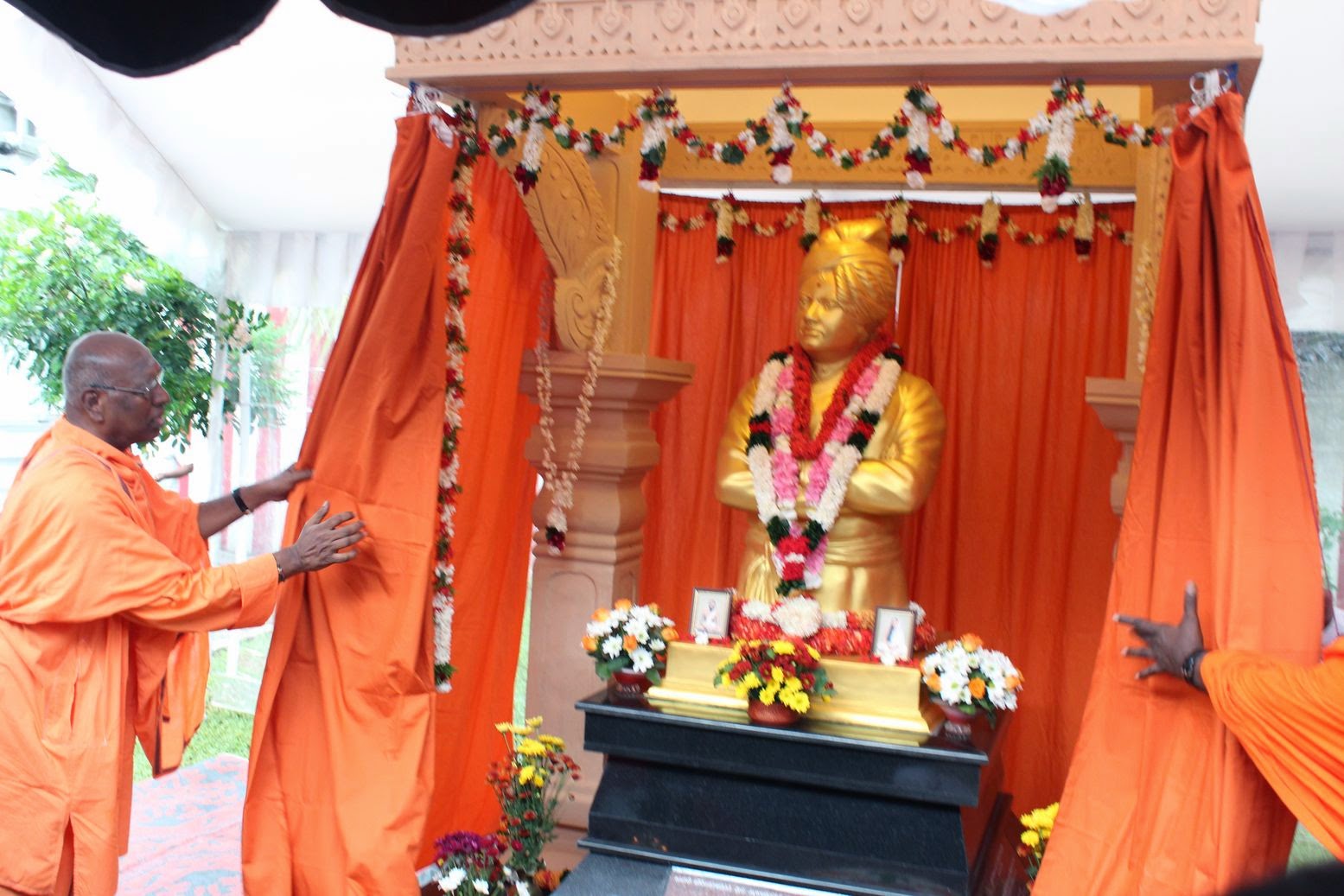
Unveiling Statue of Swami Vivekananda in Sri Ponnambalavaneswarar Temple 01-05-2014


Installation of a Bronze Statue Of Swami Vivekananda 

In Ponnambalavaneshwar Temple


Swami Vivekananda 150th Birth Annivesary Programme

 Video - of the Programme


Earlier Photos of the Temple


Swami Vivekananda in Sri Lanka - Photo