PARTIAL KNOWLEDGE BREEDS NARROWNESSFOUR blind men went out to see an elephant. One touched the leg of the elephant and said, "The elephant is like a pillar." The second touched the trunk and said, "The elephant is like a thick club." The third touched the belly and said, "The elephant is like a big jar." The fourth touched the ears and said, "The elephant is like a big winnowing basket." Thus they began to dispute hotly amongst themselves as to the shape of the elephant. A passer-by, seeing them thus quarrelling, said, "What is it you are disputing about?" They told him everything and asked him to arbitrate. The man said: "None of you has seen the elephant. The elephant is not like a pillar, its legs are like pillars. It is not like a winnowing basket, its ears are like winnowing baskets. It is not like a stout club, its trunk is like a club. The elephant is the combination of all these — legs, ears, belly, trunk and so on."
In the same manner, those who quarrel (about the nature of God) have each seen only some one aspect of the Deity.
.jpeg)
When Sri Ramakrishna had attained perfection in all the sadhanas and had become firmly established in Bhava mukha, he came to certain conclusions regarding himself and spiritual matters in general.
Regarding himself he had the conviction that
1. He was an Incarnation of God, an Adhikarika Purusha all of whose spiritual strivings were for the sake of others
2. As long as the work of Iswara’s doing good to jivas continues, he has to reincarnate himself from age to age and carry out that mission
3. He knew the time of his passing away long before his mahasamadhi .
Regarding spiritual matters in general he came to realize both by reason and through his yogic insight that
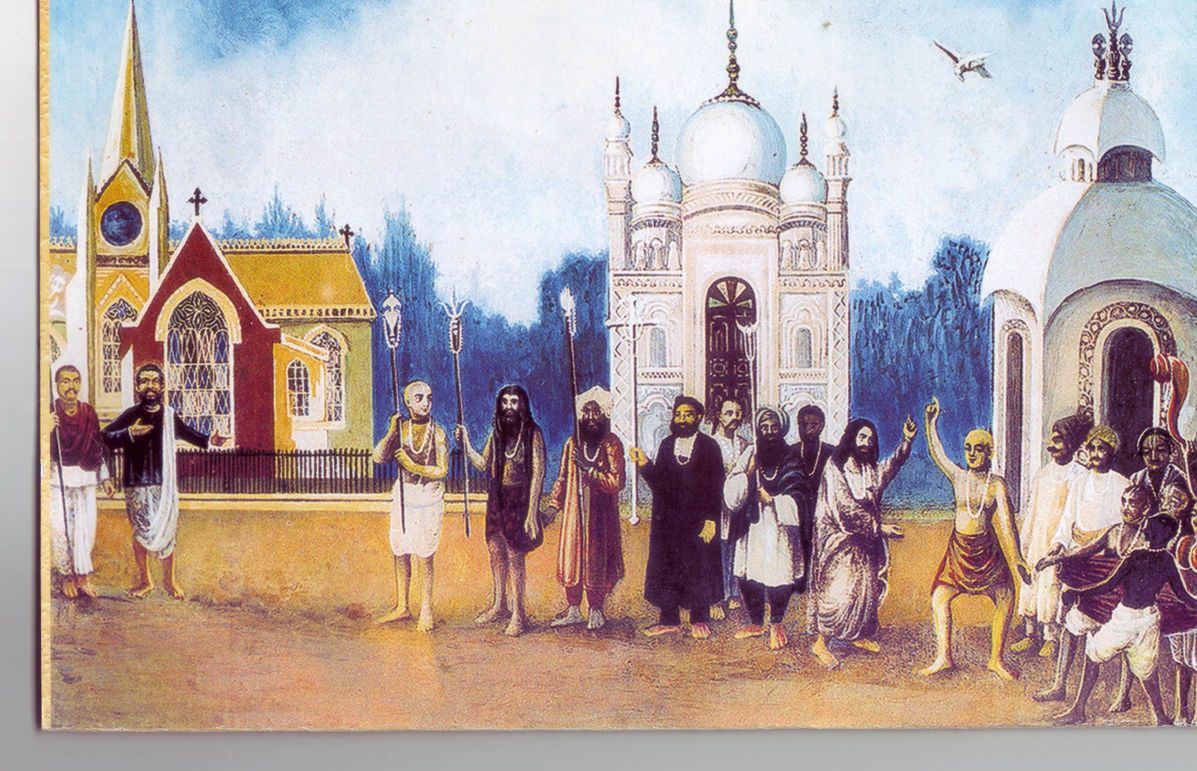
1. All religions are true and the various faiths are but so many paths to The One Godhead
2. His advent was to reveal this truth to the world and arrest the decline of religions and the quarrelling among themselves
3. The doctrines of dualism, qualified monism and monism influenced each one according to his spiritual progress
4. They are not contradictory, but complimentary to one another, depending on the evolution of the human mind
5. the non-dual state of Consciousness which is beyond the range of thought and word, is the ultimate goal to be realized
6. only the state up to qualified non-dualism can be grasped, by the mind and intellect and expressed in words, and in that state both the Absolute and the relative are equally eternal
7. The Lord Himself, His Name and His Abode are all of pure Consciousness
8. To the ordinary people attached to worldly enjoyments, the practice of dualism consisting in the disciplines of singing aloud the Lord’s name and form, His glory and powers, as presented in Narada Pancharatra, one of the devotional scriptures, is commendable
9. Performing one’s duty with a spirit of resignation to the will of and solely depending on God, the constant singing of God’s name together with meditation of Him which is Karma Yoga in practice is befitting the people of this age
10. The Mother of the Universe would found through him a new Movement to disseminate these universal doctrines illustrated in his own life
11. She would send dedicated bands of workers who would accept him as their ideal and spread his liberal doctrines and spiritual teachings to the world.
Ref:
Sri Ramakrishna the Great Master: Published by Sri Ramakrishna Math, Mylapore, Madras 600004, 1952 edition; Pages: 302-4


.jpg)
.jpg)
.jpg)




.jpeg)

.jpeg)
.jpeg)
.jpeg)
.jpeg)
.jpeg)
.jpeg)
.jpeg)
.jpeg)
.jpeg)
.jpeg)
.jpeg)
.jpeg)
.jpeg)
.jpeg)
.jpeg)
.jpeg)
.jpeg)
.jpeg)
.jpeg)
.jpeg)
.jpeg)
.jpeg)
.jpeg)
.jpeg)
.jpeg)


